© Tourism Australia
Tourism’s Climate Advantage:
Turning climate leadership into tourism value
Stronger climate leadership could attract an additional 1.1 million visitors to Australia by 2034 and unlock a potential $20.5 billion economic opportunity.
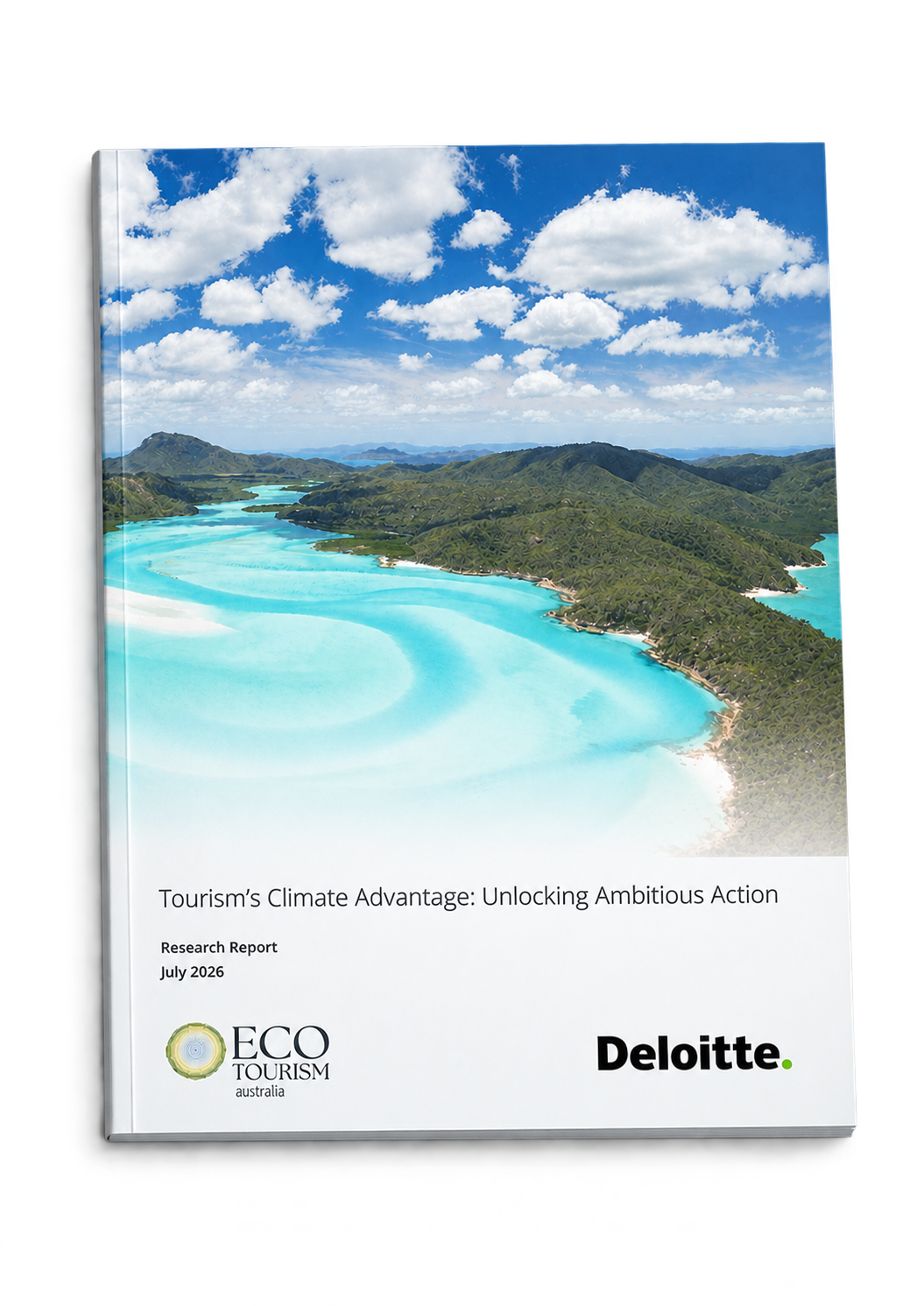
Tourism’s Climate Advantage: Unlocking Ambitious Action, developed by Ecotourism Australia in partnership with Deloitte, shows how credible climate action can also strengthen regional economies, business resilience, destination competitiveness and long-term community outcomes.
As climate change reshapes the tourism landscape, destinations, businesses and governments that demonstrate credible climate leadership will be best positioned to stand out, build resilience and capture emerging opportunities. Tourism’s Climate Advantage: Unlocking Ambitious Action, a landmark research report developed by Ecotourism Australia in partnership with Deloitte, demonstrates that climate leadership is not simply an environmental responsibility. It is a pathway to stronger regional economies, greater business resilience, enhanced destination competitiveness, and long-term community benefits.
In the 2024-25 financial year, Australia’s visitor economy contributed more than $81.1 billion to GDP underpinned by the natural and cultural assets that draw visitors to destinations across the country. As traveller expectations evolve, climate leadership is becoming a key factor in maintaining Australia’s appeal as a world-class tourism destination. The report provides evidence that ambitious climate action can help protect the assets tourism depends on while unlocking substantial economic and social value.
A framework for measuring tourism value
To understand the value of climate leadership, the report developed a framework based on five interconnected indicators. Together, these indicators demonstrate how climate action creates benefits that extend far beyond emissions reduction.
1. Reputation and market positioning
Climate leadership shapes how the world sees Australia. As travellers increasingly consider sustainability and extreme weather when choosing destinations, a strong reputation for climate action can strengthen Australia’s competitive position and attract visitors seeking responsible tourism experiences. The report highlights Australia’s opportunity to increase its attractiveness to the growing market of sustainability-conscious travellers, who may be more willing to travel to Australia and experience its natural and cultural offerings.
2. Direct tourism economic benefit
Climate leadership has the potential to generate significant economic returns for Australia’s tourism sector. Modelling in the report indicates that stronger climate leadership could attract an additional 1.1 million visitors by 2034, compared to the business-as-usual scenario and generate a potential economic opportunity of $20.5 billion, creating opportunities for tourism businesses and destinations across the country.
Tourism growth must be responsible, with a climate leadership pathway focused on quality, distribution and management, not visitor numbers at all costs. The report suggests that maintaining Australia’s tourism competitiveness will require coordinated action from government and industry.
For government, priorities include investing in climate-resilient infrastructure, planning for climate risk in destination management, supporting visitor dispersal to ease pressure on high-use destinations and spread benefits to regional communities, strengthening sustainability data, supporting First Nations-led tourism and targeting grants and incentives that cut emissions, build resilience and protects natural and cultural assets.
For industry, priorities include designing high-value experiences without adding pressure on sensitive destinations, adopting credible sustainability certification, managing resources such as waste, water and energy efficiently, creating partnerships with First Nations and local communities on culturally respectful tourism products that deliver benefits effective, and manage peak-period pressure appropriately.
3. Business resilience and cost pressures
Climate risks are increasingly influencing operating costs, particularly through insurance as a recurring business cost. The report modelled annual insurance costs for certified ecotourism businesses and showed insurance pressure could add $87.1 million under a moderate (7.2%) scenario and $161.8 million under a high (10%) scenario by 2050, compared with a $29.7 million CPI-only baseline.
These rising business costs place significant pressure on operators, especially small and regional tourism businesses. Building resilience and reducing climate risks can help protect profitability, support investment, and strengthen long-term viability.
4. Economic benefits beyond tourism
The benefits of climate leadership flow well beyond the tourism industry. Increased visitor spending supports transport, retail, hospitality, agriculture, construction, professional services and other sectors that contribute to regional economies. Climate leadership can act as a catalyst for broader economic development and resilience across communities and industries.
5. Social benefits for regional communities
Tourism plays a vital role in supporting regional communities, and climate leadership can enhance these benefits. The report identifies opportunities to strengthen workforce capability, support local employment, build community resilience, increase social cohesion and create opportunities for First Nations engagement and cultural connection. Climate action is not only an economic strategy but also an investment in stronger, more resilient communities.
The opportunity for Australia
Across all five indicators, the message is consistent: climate leadership can strengthen Australia’s tourism competitiveness, economic value and social resilience. Businesses, destinations and governments that reduce emissions, manage climate risk, protect natural and cultural assets and demonstrate credible progress will be better positioned to meet changing visitor expectations and thrive in a more climate-conscious global market.
Importantly, the opportunity is not simply about attracting more visitors. It is about creating higher-value, better-managed tourism that supports regional economies, protects the places people come to experience, and delivers benefits for local communities.
Turning opportunity into action
Drawing on the report’s findings across reputation, economic value, insurance cost, broader economic benefits and social impacts, the following five actions translate climate leadership from ambition into practical, sector-wide impact.
- Build a credible, measurable national sustainable tourism brand: anchored in certification, transparent reporting and measurable improvement on sustainability indicators including climate mitigation, conservation and climate resilience.
- Invest in climate adaptation for high-value tourism assets and infrastructure: with clear delineation of public investment in natural asset protection and enabling infrastructure, and support for private operator-level adaptation.
- Support small operators to build resilience, manage risk and increase capacity and capability: support small operators to build resilience, decarbonise operations and demonstrate credible progress. Some tourism businesses are already investing in emissions reduction and adaptation, but require policy settings, infrastructure and support mechanism that enable them to progress climate action. This can include targeted programs, tools and data focused on addressing climate risks and business pressures, building climate-related skills and climate literacy.
- Establish a national sustainable tourism monitoring and accountability framework: to track demand, regional vulnerability, reputation performance and progress against decarbonisation and adaptation targets.
- Align tourism decarbonisation with destination resilience through coordinated sector governance: integrating emissions reduction into destination management, linking adaptation investment to decarbonisation pathways, and ensuring alignment across policy, operators, communities, First Nations partners and conservation stakeholders.
Request the report
Climate leadership represents one of the greatest opportunities for Australia’s visitor economy. By acting now, Australia can strengthen its reputation, grow regional economies, build business resilience and help ensure the destinations we value today continue to thrive into the future.
Request a copy of Tourism’s Climate Advantage: Unlocking Ambitious Action report for the evidence, insights and recommendations tourism businesses, destinations and governments can use to manage climate risk, strengthen resilience and turn climate leadership into lasting value.
Request the Climate Advantage report by entering your details below: